

We live in a healthcare system that pours massive amounts of money into treating sick people, often just managing symptoms, while investing very little in prevention. Pharmaceutical companies profit when diseases are caught late because it often means lifelong medication.
Standard medical check-ups often include routine blood tests that focus on making sure you’re “not dying” rather than optimising long-term health and checking for key indicators of disease risk. Plus in the standard small or large blood count, hardly any nutrients are actually measured.
This stems from a viewpoint that nutrition does not play a major role in health. In Switzerland, medical students receive only about 10-20 hours of nutrition education. That is frightening.
There exist many tests that are early warnings for nutritional deficiencies. Those rarely cause immediate danger, but they manifest through symptoms like fatigue, low energy, numbness, poor wound healing and recovery, skin issues, or even depression. Left untreated, these seemingly minor issues can develop into serious, chronic health problems.
If you catch nutritional deficiencies early through the right tests, you can often address them by changing your nutrition, improving gut health, lifestyle, or adjusting your supplements before they develop into serious conditions like heart disease, diabetes, or cancer.
Cardiovascular diseases build very slowly over decades.
You don’t want to wait for the first symptoms because in many cases, the first symptom is a fatal heart attack!
Most doctors still work with LDL or non-HDL instead of ApoB for the lipid profile because these tests are cheaper. LDL is less specific for assessing the risk of atherosclerosis and cardiovascular disease.
Getting the right blood tests is a crucial step in understanding your current health and preventing potential diseases before they arise.
Many labs will let you order directly if you know what to ask for.
That’s why I created a practical blood test spreadsheet with stricter reference values than most labs, designed to guide your next blood test and help you understand your own lab results. It answers questions such as:
- Which tests are particularly relevant for assessing if you are getting all the necessary nutrients?
- Which tests are the most reliable? There are for example four different tests to check for B12.
- The “normal” reference ranges are based on the general population, most of whom are not metabolically healthy. So what are optimal levels? How can you interpret your lab results?
- What does a test tell you exactly and when is it good to repeat it?
- Which tests help you understand your current health and prevent potential diseases before they arise?
I don’t think it makes any sense to test for vitamin D if you’re not supplementing. The value will most likely be too low (unless you test in summer in Europe). 60-70 % of the population in Switzerland in winter have a vitamin D deficiency. Vitamin D is needed for the production of serotonin, among other things. A shortage can enhance depressive symptoms.
But I have seen too often that either friends or clients of mine have vitamin D deficiencies even though they are supplementing. This means that a test can help to set the optimum dose that works for you.
The Problem With “Normal”
Many of us believe that if our doctor says our blood work looks “normal,” we are fine. But here’s the catch: Normal does not mean optimal.
Those “normal” reference ranges are based on the general population, most of whom are metabolically not healthy.
Over the years, I’ve noticed how labs shift ranges. So what was once a warning flag may suddenly be considered “normal.” Reference values vary depending on the laboratory and country. There are no legal regulations that require the laboratory to use a specific reference value. This can lead to a false sense of security.
And here’s something else many don’t realise: In the standard small or large blood count, hardly any nutrients are actually measured. Apart from iron (indirectly through hemoglobin), most key nutritional markers are missing.
Vitamin D, B12, or omega-3s, can be measured, but even here it’s not straightforward. Did you know there are four different tests just for vitamin B12 and they can give very different results?
Instead of aiming for what is considered normal, strive for optimal levels to support longevity and overall well-being.
Knowledge is Power
In many cases, these specialised tests are not covered by health insurance (at least in Switzerland). However, you can visit an independent laboratory without a doctor’s referral and request the tests directly.
But for that it is useful to know what you want to test for and how to interpret the test results.
Many providers offer test packages with useful but sometimes incomplete or less relevant tests. Which is often more expensive than ordering the tests you want independently.
That is why I created this spreadsheet. To help you gain a clear overview of what truly matters.
Some of those tests can be expensive. But compared to the cost of heart disease, diabetes, or cancer, not only financially but also emotionally and physically, it’s a bargain.
If we can afford it, isn’t it worth investing in ourselves before something breaks down?
Taking Health into my own Hands and my Learnings
I wanted clarity, so I decided to invest in a series of advanced tests. Among them were also a full amino acid profile and a full fatty acid profile.

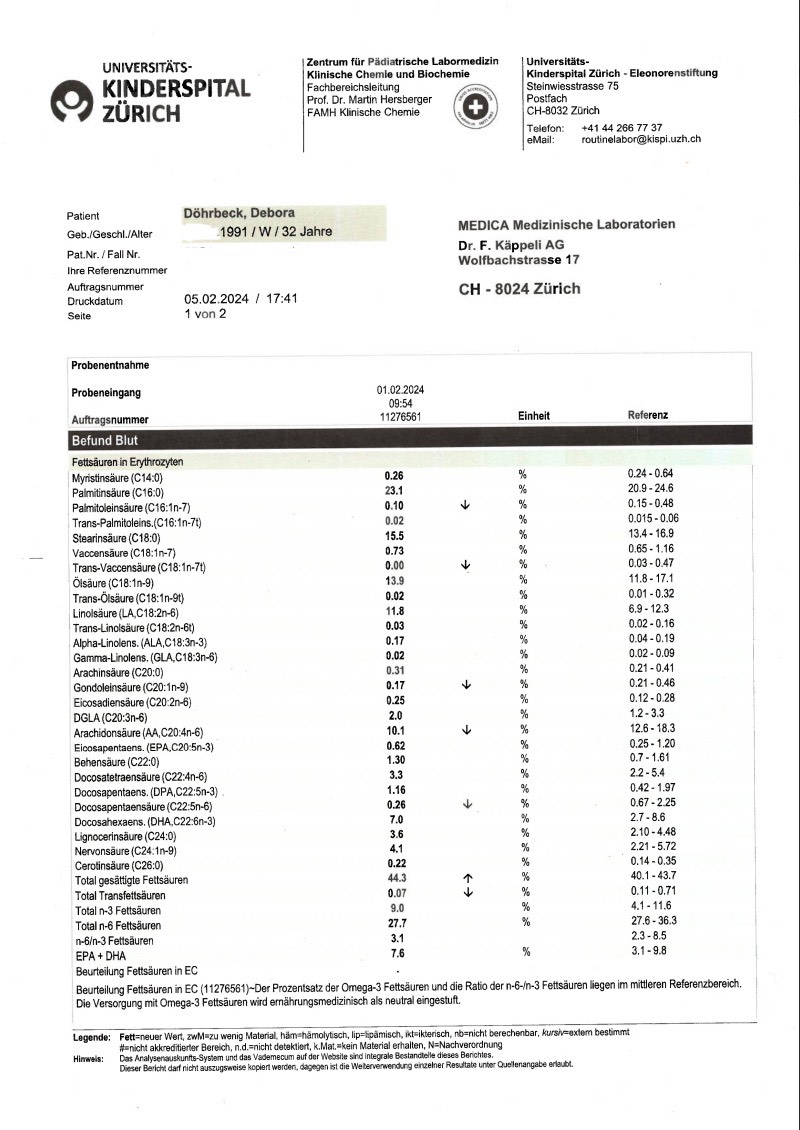
My learnings:
- My omega-6 to omega-3 ratio was 3.1:1. For comparison, the Western average is around 15:1 to 20:1. A range strongly linked to increased inflammation. The optimal ratio is closer to 2:1 or even 1:1. Based on that, I increased my omega-3 intake (EPA + DHA) from 1500 mg to 2000 mg per day.
- My total saturated fat level was a bit higher than expected for a person eating vegan. Since then I reduced the amount of cacao butter, coconut oil, and coconut milk I eat.
- My arachidonic acid (AA) was on the lower side. But since the conversion from linoleic acid (LA) to AA is demand-regulated and my LA levels are sufficient, I am not concerned. And because omega-6 and omega-3 fatty acids compete for the same metabolic pathways, I won’t start supplementing AA.
- Out of all the amino acids (building blocks of proteins), only proline was slightly below the optimal range. However, proline is a non-essential amino acid, meaning the body can synthesise it on its own as long as the necessary building blocks are available.
- My folate was too low. Even though I eat a green smoothie and a leafy green salad daily. So I switched my supplement provider.
- My LH/FSH ratio was higher, which was an indication that I may have PCOS. It turned out to be true. Luckily I do not have any symptoms other than longer cycles when feeling stressed.
Final Thoughts
We don’t wait until our car engine breaks down to change the oil.
So why do so many wait until our body breaks down to invest in it?
Don’t wait for the crisis. Consider looking deeper now.

 Minimalist Traveller
Leave a comment